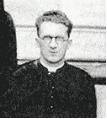
Monsignor Hugh O'Flaherty
The Books.
 Irish newspaperman J.P. Gallagher first heard about Hugh O’Flaherty while covering the war front, and was largely responsible for bringing the Monsignor’s story to the attention of the world at large. In one feature the reporter dubbed O’Flaherty the “Scarlet Pimpernel of the Vatican,” after the fictional hero of a popular adventure series by novelist Emma Orczy. The name stuck.
 After the war, Gallagher continued to be intrigued by the story. After much pleading on the reporter’s part, the reluctant Monsignor was persuaded to give one interview. This, plus much research and many other interviews with people who knew, helped, or were helped by the priest, became the basis for Gallagher’s book, Scarlet Pimpernel of the Vatican, published in the late sixties.
With true Irish storytelling flair, Gallagher makes Scarlet Pimpernel of the Vatican read like a novel. The book moves chronologically through O’Flaherty’s life, focusing most closely on the war years. The chapters are filled with fascinating anecdotes (who knew that the one of the refugees, a young Yugoslav med student, would end up marrying actress Gina Lollobrigida?). O’Flaherty may come across as larger than life, but he never seems less than real. Any writer knows how hard it is to portray an honestly good person; in this Gallagher has succeeded.
Gallagher does have the attitudes of his era, a definite pro-British slant, and a regrettable tendency to fictionalize dialogue of the “Wait! We kom!” variety for the Germans. But on the whole the book is well-written, fast-paced, and never disappoints. Scarlet Pimpernel of the Vatican is out-of-print now, and a bit hard to find, but if you’re seriously interested in the Monsignor, it’s worth tracking down.
For a long time, Gallagher’s book was the only source of information about Hugh O’Flaherty’s life and career. But the Monsignor’s story has been getting more attention since 2008, when Irish writer Brian Fleming brought out his new biography, The Vatican Pimpernel: The Wartime Exploits of Monsignor Hugh O’Flaherty The publication of this book marks the first serious study of the Monsignor in more than forty years.
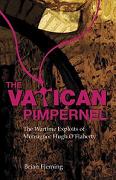 Fleming, a former member of the Oireachtas (Irish Parliament), and principal at Collinstown Park Community College in Dublin, has done an excellent job of giving us a contemporary analysis of O’Flaherty’s life. A great deal of research obviously went into the book, and Fleming has gotten as close to the original sources as he can in every case. While the story is basically the same as it is in Gallagher’s book (a tribute to O’Flaherty’s integrity, really), The Vatican Pimpernel offers us a wealth of new information.
Fleming spends some time on the various political situations, expanding the stage on which the story is set. There are several new exploits to be added to the Monsignor's legend, and new details about the old ones. Many characters whose small roles were previously overlooked are now given their due. And we get more of a sense of O'Flaherty himself, as a man and a priest, not just a hero.
The Vatican Pimpernel may not be as sensational as Gallagher’s book, but you will still be absorbed in its pages. Fleming’s straightforward prose sets off the heroism of O’Flaherty and co. with all the simple style of a roman collar. As true-story reading goes, the book is quite enjoyable.
The Movie.
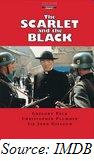 J.P. Gallagher’s book was the main inspiration for the 1983 TV movie, The Scarlet and the Black, which dramatizes O’Flaherty’s rescue efforts during the German occupation of Rome. Gregory Peck stars as Hugh O’Flaherty, Christopher Plummer plays Col. Herbert Kappler, and Sir John Gielgud takes a turn as Pope Pius XII. The film’s opening scene portrays the painting of the white line across the opening of St. Peter’s Square, effectively underscoring the theme of the whole movie: is it possible that something or someone will be able to hold God back? The second scene introduces us to O’Flaherty, who is giving the Swiss Guards a boxing lesson. Immediately we understand that for this man, there is no line painted between heaven and earth.
The film stays true to the book in generalities. Sam Derry has been quietly left out, the better to highlight O’Flaherty’s role. Mrs. Chevalier has been turned into Francesca Lombardo, an attractive Maltese widow with two daughters. John May is renamed “Mr. West,” but the character is stilled played as one part Jeeves, two parts Artful Dodger. And every villain in the story has been rolled into Col. Kappler, a man more subtly drawn than your typical film Nazi; we see him order death and torture, yet we also see his honest devotion to his rather brainless wife Nina and their two bratty children.
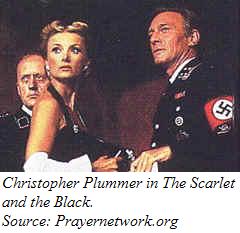 The movie has a good time with some of the legends about O’Flaherty, especially the one about his disguises: we see him dressed as a street sweeper, a nun, even (ahem) a Nazi officer. It also makes the enmity between Kappler and O’Flaherty more personal. In one tense scene, the priest insolently saunters along the very edge of the white line, while Kappler, at a nearby window, watches through the sights of a sniper’s rifle, his finger quivering on the trigger. At the end, the movie takes another departure from strict accuracy, but still remains within the spirit of O’Flaherty’s story.
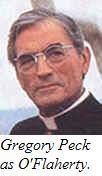 The film was shot on location and the sights of Rome provide a beautiful backdrop for the action. The soundtrack has unfortunately not worn very well, but the screenplay is still snappy. Gregory Peck plays the unconventional priest with Irish charm; he is, perhaps, a little too steely around the eyes, but otherwise his performance is wonderful. And if you only know Christopher Plummer from his role as the noble and anti-Nazi Captain VonTrapp in The Sound of Music, then you are in for a surprise. The Scarlet and the Black has no rating, but I would give it a PG-13; there is no language or sexuality, but there are some scenes of violence (Jewish people are rounded up and pushed into trucks, a man is executed by a firing squad—but nothing is too explicit). If you like to be both inspired and entertained, this is a movie to add to your collection.